
Last year, my neighbor Lisa went on a health kick.
She swapped soda for fruit juice. Replaced her afternoon candy bar with a granola bar. Started every morning with flavored yogurt and a smoothie she found on Instagram. She was proud of herself, and honestly, so was I.
Three months later, she had gained four pounds.
“I do not understand,” she told me over coffee, looking genuinely defeated. “I cut out all the junk. I am eating healthy. What am I doing wrong?”
The answer broke her heart a little: almost everything she had switched to was loaded with sugar. Sometimes more sugar than the “junk” she had given up.
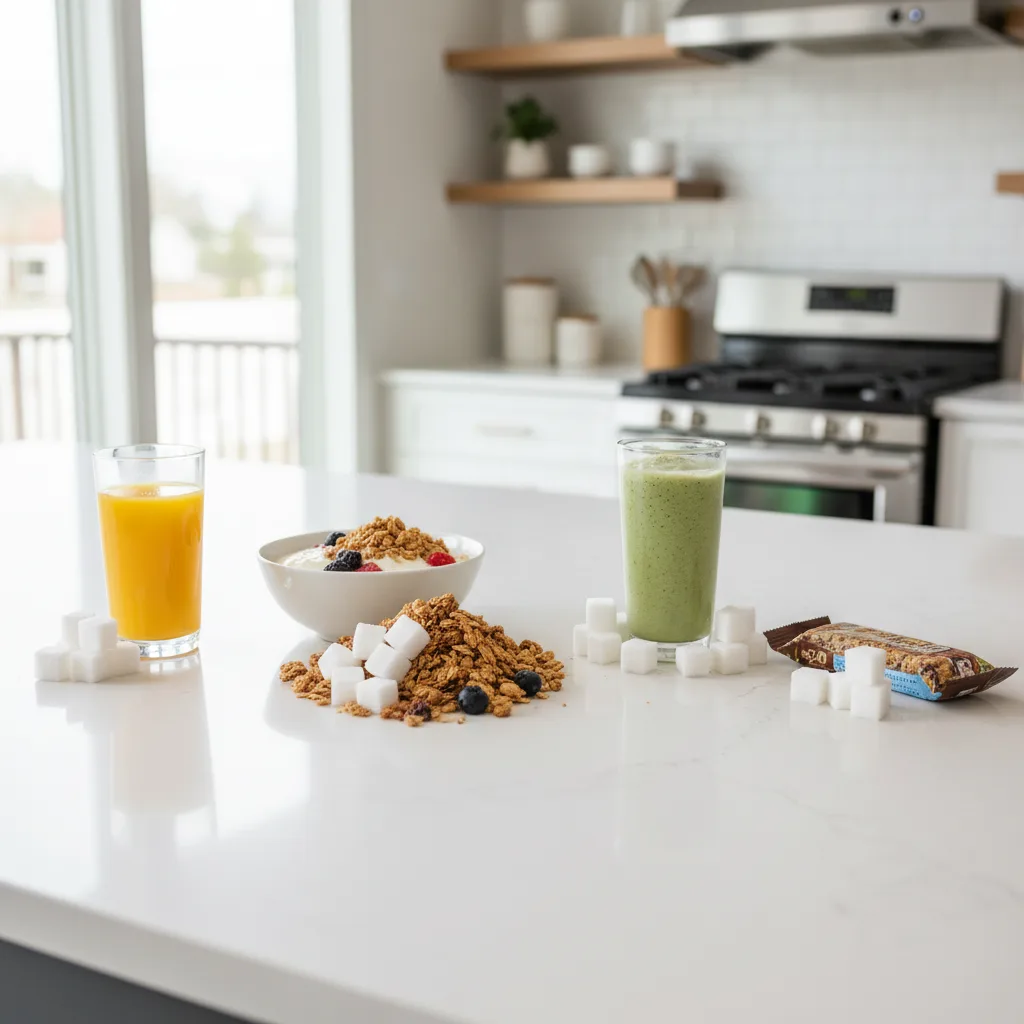
The Sugar You Never Agreed To
Here is a number that might make you put down your granola bar: the average American consumes about 77 grams of added sugar per day. That is roughly 17 teaspoons. The American Heart Association recommends no more than 25 grams for women and 36 grams for men.
But here is what makes it so frustrating: most of that sugar is not coming from cookies and cake. It is hiding in foods that are marketed as healthy. Foods you buy specifically because you are trying to do the right thing.
Let me walk you through some of the worst offenders.
The “Healthy” Foods That Are Secretly Full of Sugar
Flavored Yogurt
This one hurts because yogurt feels so virtuous. But a single container of flavored yogurt can pack 20 to 26 grams of sugar. That is almost as much as a Snickers bar.
Plain Greek yogurt? About 4 to 5 grams of naturally occurring sugar from lactose. The difference is staggering.
If plain yogurt tastes too boring, try adding a handful of fresh berries and a drizzle of honey. You will still end up with a fraction of the sugar, and you will actually taste the fruit instead of artificial strawberry flavor.
Granola and Granola Bars
Granola has somehow earned a reputation as a health food, and I genuinely do not know how. Most commercial granolas contain 12 to 16 grams of sugar per serving. And let us be honest, nobody eats just one serving of granola.
Granola bars are even trickier. Many popular brands pack 10 to 15 grams of sugar into a single bar. Some contain more sugar than a chocolate chip cookie. Read the label. If sugar, honey, or syrup is one of the first three ingredients, it is a candy bar in disguise.
Fruit Juice
This was Lisa’s biggest shock. She thought swapping soda for orange juice was a no-brainer. But a glass of orange juice contains about 21 grams of sugar. A glass of Coca-Cola? About 26 grams.
The difference is almost meaningless.
Whole fruit is completely different. When you eat an orange, you get fiber that slows down sugar absorption, plus vitamins and water that help you feel full. Juice strips all of that away and gives you a concentrated sugar hit that spikes your blood sugar almost as fast as soda.
Smoothies
Smoothies can be incredibly healthy or secretly terrible, depending on how they are made. Most store-bought smoothies and juice bar smoothies contain 40 to 80 grams of sugar per serving. That is not a health drink. That is dessert.
The problem is usually the portions and the ingredients. Fruit juice as a base, multiple types of fruit, flavored yogurt, honey, and sometimes sherbet or frozen yogurt. It adds up fast.
A genuinely healthy smoothie uses a base of water or unsweetened almond milk, one serving of fruit, a handful of spinach or kale, and a scoop of protein powder. Not as Instagram-worthy, but your body will know the difference.
Salad Dressing
You make a beautiful salad with grilled chicken, vegetables, and avocado. Then you pour two tablespoons of honey mustard dressing on top and add 8 to 10 grams of sugar. Some dressings are even worse. Certain fat-free dressings replace the fat with sugar to make up for the lost flavor.
Olive oil and vinegar. That is all you need. A squeeze of lemon, some salt and pepper. Your salad was doing just fine before the dressing showed up.
Protein Bars
The fitness industry has done an incredible job of making candy bars look like health food. Some popular protein bars contain 20 to 30 grams of sugar. You could eat two scoops of ice cream for less.
Look for bars with fewer than 5 grams of sugar and at least 15 grams of protein. They exist. They just do not have the flashiest packaging.
Instant Oatmeal
Plain oatmeal is one of the best breakfasts you can eat. But those convenient little flavored packets? They can contain 12 to 15 grams of added sugar before you even sit down.
Buy plain oats. They take two minutes longer to prepare. Add cinnamon, a few walnuts, and some sliced banana. You get all the comfort with none of the sugar crash.
Why Hidden Sugar Matters for Weight Loss
You might be thinking, “Okay, so there is some extra sugar. Is it really that big of a deal?”
Yes. Here is why:
Sugar spikes your insulin. When you eat sugar, your blood glucose rises, and your body releases insulin to bring it back down. Insulin is also your fat-storage hormone. Chronically elevated insulin makes it nearly impossible to burn stored fat, no matter how much you exercise.
Sugar makes you hungrier. That blood sugar spike is always followed by a crash. And when your blood sugar drops, your brain screams for more fuel. You feel hungry, shaky, irritable, and desperate for another quick fix. It is a cycle that keeps you eating more than you need.
Sugar is addictive. Research from Connecticut College found that Oreos activated more neurons in the pleasure center of rats’ brains than cocaine did. While human addiction is more complex, there is no question that sugar triggers powerful reward pathways that make it very hard to stop at “just a little.”
Sugar hides under 60 different names. Sucrose, high fructose corn syrup, dextrose, maltose, barley malt, rice syrup, agave nectar, cane juice, fruit juice concentrate… food companies know you are reading labels now. So they split the sugar into multiple types so none of them appear as the first ingredient. Clever, right?
How to Fight Back
You do not need to eliminate sugar completely. That is unrealistic and unnecessary. But you do need to know where it is hiding so you can make informed choices. Here is how:
Read every label. Not the front of the package. The nutrition facts panel. Look at “Added Sugars” specifically. Ignore marketing words like “natural,” “organic,” or “no artificial sweeteners.” They mean nothing when it comes to sugar content.
Follow the 5-gram rule. For any packaged food, aim for 5 grams of added sugar or less per serving. It is a simple guideline that eliminates most of the worst offenders automatically.
Eat whole foods when possible. The simplest way to avoid hidden sugar is to eat food that does not come in a package. Vegetables, fruits, eggs, meat, fish, nuts, legumes. These foods do not need ingredient lists because they are the ingredient.
Give your taste buds two weeks. When you reduce sugar, everything tastes bland at first. That is normal. Your taste buds have been overstimulated. But after about two weeks of eating less sugar, something amazing happens: fruit starts tasting incredibly sweet. Plain yogurt tastes creamy and satisfying. Your palate recalibrates, and you start actually tasting your food instead of just tasting sugar.
What Happened to Lisa
Lisa was frustrated at first. She felt deceived, like the food industry had been lying to her. And honestly, it kind of had.
But once she started reading labels and swapping her “healthy” foods for genuinely healthy alternatives, things changed fast. She replaced the flavored yogurt with plain Greek yogurt and berries. Swapped juice for water with lemon. Traded granola bars for a handful of almonds.
She did not go on a diet. She just stopped eating sugar she never knew she was eating.
Within six weeks, she lost the four pounds she had gained and then some. But more importantly, she said she felt different. Less foggy. More energy. Fewer cravings. No more 3 PM crash.
“I cannot believe how much better I feel,” she told me. “And I am not even trying that hard.”
That is the thing about hidden sugar. Once you see it, you cannot unsee it. And once you stop eating it without realizing, your body responds faster than you would ever expect.
The next time you pick up something labeled “healthy,” flip it over. Check the sugar. You might be surprised by what you find — and even more surprised by how good you feel when you put it back.